
A practical guide for English speakers living in France — Part 2 of our two-part series on medical emergencies in France.
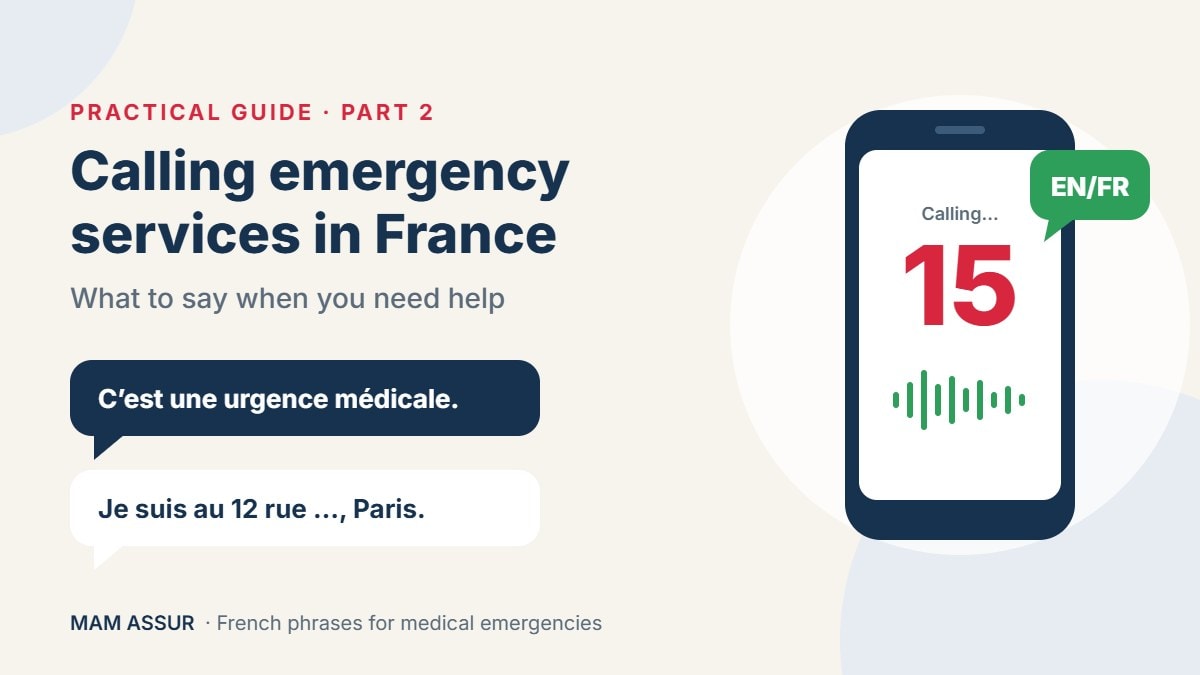
A medical emergency can make communicating clearly difficult, particularly when you’re dealing with an unfamiliar healthcare system in another language.
In Part 1 of our series, we explained which emergency numbers to call, when to contact the SAMU, where to find urgent medical care, and what happens when an ambulance arrives.
In this second article, we explain how to communicate with emergency services, including what information to provide, how to explain symptoms, and useful French phrases to keep handy. You’ll find French translations for common symptoms and medical emergencies in the tables below.
1. Will Someone Speak English When You Call?
Possibly, but you shouldn’t rely on it.
Emergency call centers operate across France, and language assistance can vary depending on the department and available staff.
Some operators speak English. Some centers may have access to interpretation services.
However, neither an English-speaking operator nor an interpreter is guaranteed.
You may have heard that calling 112, the European emergency number, is a better option if you don’t speak French. However, calling 112 instead of 15 does not guarantee an English-speaking responder either.
A little preparation can help enormously.
- Keep your address written in French.
- Save important medical vocabulary.
- Write a short summary of any significant medical conditions.
- Keep a translation app on your phone.
- If appropriate, arrange with a trusted French-speaking friend or neighbor to help communicate during an emergency.
If someone else calls on your behalf from another area of France, they should clearly explain the patient’s exact location. Emergency calls are handled through geographically organized services.
2. How to Explain Your Emergency Clearly
One of the biggest challenges may be communicating the seriousness of a situation.
You may know enough French for everyday life but struggle to describe medical symptoms. Regardless of your French level, communicating the critical information in a stressful moment or when ill or injured can be challenging.
The important thing is to be as clear and specific as possible.
Start with the most important information
When speaking to emergency services, explain where you are, what has happened, who needs help, and what symptoms they’re experiencing. Be sure to mention when the symptoms began and whether the person’s condition is getting worse.

These examples can help you communicate that information in French.
| Information to provide | What to say in French |
|---|---|
| Where you are | Je suis au [adresse, ville]. (I’m at [address, city].) |
| What has happened | Il y a eu un accident. (There’s been an accident.) |
| Who needs help and their age | C’est un homme de 70 ans. (It’s a 70-year-old man.) |
| What symptoms they’re experiencing | Il a très mal à la poitrine. (He has severe chest pain.) |
| When the symptoms began | Les symptômes ont commencé il y a 20 minutes. (The symptoms started 20 minutes ago.) |
| Whether the condition is worsening | Son état s’aggrave. (His condition is getting worse.) |
The examples use a male patient, but you can adapt them to your situation. For a woman, for example, you would say « C’est une femme de 70 ans » or « Elle a très mal à la poitrine. »
For example, instead of simply saying someone is feeling unwell, explain that they have severe chest pain, are struggling to breathe, or have suddenly become confused.
Don’t minimize symptoms out of politeness or a desire not to cause trouble.
Equally, there’s no need to exaggerate. Accurate information helps the medical team make the right decisions.
Use the pain scale
French medical professionals commonly use a scale from 0 to 10 to assess pain.

| Pain score | English | French |
|---|---|---|
| 0 | No pain | Aucune douleur |
| 1–3 | Mild pain | Douleur légère |
| 4–6 | Moderate pain | Douleur modérée |
| 7–9 | Severe pain | Douleur intense |
| 10 | Worst imaginable pain | Douleur maximale imaginable |
You can say:
« Ma douleur est de huit sur dix. »
My pain is eight out of ten.
Remember that the pain score is only one part of the assessment. Some serious emergencies, including strokes, may involve little or no pain.
Mention relevant medical history
Tell the medical team about conditions that may affect the situation, such as:
- Previous heart attacks or strokes.
- Diabetes or other significant chronic conditions.
- Serious allergies.
- Recent surgery or hospitalization.
- Current medications, especially blood thinners.
This information may influence the response.
3. What If You Don’t Agree With the Advice?
Sometimes a caller may feel that the seriousness of a situation hasn’t been fully understood.
If you’re concerned, explain why.
You can ask the medical professional to clarify their recommendation and describe any symptoms that you believe need further attention.
If the situation worsens, call 15 again. You are not limited to one call.
Tell the operator that you have already spoken to the service, explain what advice you received, and describe exactly what has changed.
For example:
« J’ai déjà appelé le 15, mais son état s’est aggravé. »
I’ve already called 15, but their condition has worsened.
New symptoms or a deterioration in the patient’s condition may change the medical assessment.
4. Essential French Phrases for Medical Emergencies
You don’t need perfect French to communicate important information.
Learning a few key phrases, or keeping them written somewhere accessible, can be extremely useful.
Explaining the situation
| English | French |
|---|---|
| It’s a medical emergency. | C’est une urgence médicale. |
| I need an ambulance. | J’ai besoin d’une ambulance. |
| I don’t speak French well. | Je ne parle pas bien français. |
| Do you speak English? | Parlez-vous anglais ? |
| The person is unconscious. | La personne est inconsciente. |
| They aren’t breathing. | La personne ne respire pas. |
| They’re having difficulty breathing. | La personne a du mal à respirer. |
| I think they’re having a stroke. | Je pense que la personne fait un AVC. |
| They have chest pain. | La personne a une douleur thoracique. |
| They’re bleeding heavily. | La personne saigne beaucoup. |
| Their condition is getting worse. | Son état s’aggrave. |
Describing medical problems
| English | French |
|---|---|
| Heart attack | Infarctus |
| Stroke | Accident vasculaire cérébral (AVC) |
| Severe allergic reaction | Réaction allergique grave |
| Anaphylactic shock | Choc anaphylactique |
| Seizure | Crise convulsive |
| Low blood sugar | Hypoglycémie |
| High blood sugar | Hyperglycémie |
| Broken leg | Jambe cassée |
| Fall | Chute |
| High fever | Forte fièvre |
| Vomiting | Vomissements |
| Dizziness | Vertiges |
Save these phrases on your phone or print a copy for your home.
5. Prepare an Emergency Information Sheet Before You Need It
This is one of the simplest and most useful preparations you can make.
Keep an up-to-date information sheet somewhere accessible at home, and consider carrying a smaller version in your wallet or on your phone.

Emergency medical information checklist
- ☐ Full name and date of birth
- ☐ Home address, including building and apartment details
- ☐ Name and contact details of your médecin traitant
- ☐ Important medical conditions and previous surgeries
- ☐ Current medications and dosages
- ☐ Allergies, particularly medication allergies
- ☐ Carte Vitale / Assurance Maladie information
- ☐ Mutuelle or private health insurance details
- ☐ Emergency contacts in France
- ☐ Next-of-kin contact information
- ☐ Information about vulnerable household members or pets needing care
- ☐ Relevant access instructions for emergency responders
Be thoughtful about where you store sensitive personal information, particularly door codes or key locations.
Don’t forget your phone’s emergency information
Many smartphones allow you to store medical conditions, medications, allergies, and emergency contacts that can be accessed from the lock screen.
Take a few minutes to complete this information and keep it updated.
If you live alone, consider arranging a check-in system with someone you trust or exploring an emergency alert device.
Read Part 1 of Our Medical Emergencies in France Series
Part 1: Medical Emergencies in France: Who to Call and Where to Go
Emergency numbers, when to call 15 before going to urgences, alternatives for urgent but non-emergency medical care, and what happens when an ambulance arrives.
Related reading
- How Do I Find a Doctor in France?
- What Is a Médecin Traitant (MT), and Why Do I Need to Declare One?
- Health Insurance for Expats in France: The Complete 2026 Guide
MAM ASSUR — For guidance on French healthcare registration, international health insurance, and complementary health insurance (mutuelles), email us at contact@mamassur.com or compare mutuelles in 2 minutes on devis.mamassur.com.